

 1-888-601-9980

- Term life is significantly cheaper than whole life or no-medical insurance across all age groups
- Insurers like Beneva, BMO, and Canada Life consistently offer the most competitive term rates in Canada
- A healthy, non-smoking 20-year-old can secure $100,000 in term coverage for roughly $10 per month
- Securing a fully underwritten policy while you are young, healthy, and a non-smoker is the most effective way to lock in the lowest lifelong premiums
The cheapest life insurance policy in Canada is term life insurance, with premiums starting as low as $10 per month for young and healthy applicants. However, the lowest-cost policy for you depends on your age, health, coverage amount, and the insurer you choose. Some of the cheapest life insurance providers in Canada include Beneva, BMO, Canada Life, Desjardins, and a few others.
Quick summary:
| Cheapest for | Company name |
| Term life insurance | Beneva |
| Whole life insurance | Foresters |
| No-medical life insurance | UV Insurance |
| Seniors | Canada Life |
How much does Life Insurance cost?
Get instant quotes from Canada's top life insurance providers and find the perfect coverage for your family.
Powered by

Which type of life insurance is cheapest?
Term life insurance is the cheapest type of life insurance in Canada. For a healthy, non-smoking Canadian, a 20-year term policy with $100,000 in coverage starts at just $10.08 per month at age 20, compared to $70.74 per month for a 20-pay whole life policy and $14.40 per month for a no-medical life insurance policy. Premiums increase with age for all policy types; term life remains the most affordable option across every age group.
Term life insurance is the most affordable option for four primary reasons:
- No cash value: Unlike whole life insurance, term life insurance does not build cash value or investment savings, keeping premiums focused on the death benefit
- Temporary coverage: It protects for a fixed period, such as 10, 20, or 30 years. If you outlive the term, the policy simply expires unless you renew or convert it
- Simple policy design: Term life focuses solely on providing a death benefit without additional features like dividends
- Lower claim risk: Because term life covers you for a fixed period, insurers are less likely to pay a death benefit than with lifelong coverage
The table below compares the monthly cost of term life, whole life, and no-medical life insurance for non-smokers across different age groups. As age increases, premiums rise for all policy types, but term life remains the lowest-cost option at every age.
Term life vs Whole life vs No-medical life insurance costs:
| Age (in years) | Term life insurance | Whole life insurance | No-medical insurance |
| 20 | $10.08 | $70.74 | $14.40 |
| 30 | $10.35 | $100.35 | $15.30 |
| 40 | $14.13 | $141.66 | $19.26 |
| 50 | $29.43 | $223.61 | $41.40 |
| 60 | $86.85 | $317.15 | $131.13 |
Disclaimer: Premiums shown are illustrative monthly rates for a healthy, non-smoking male purchasing $100,000 in coverage for a 20-year term. Actual premiums vary based on factors such as age, gender, medical history, lifestyle, insurer, and more.
What factors affect life insurance costs in Canada?
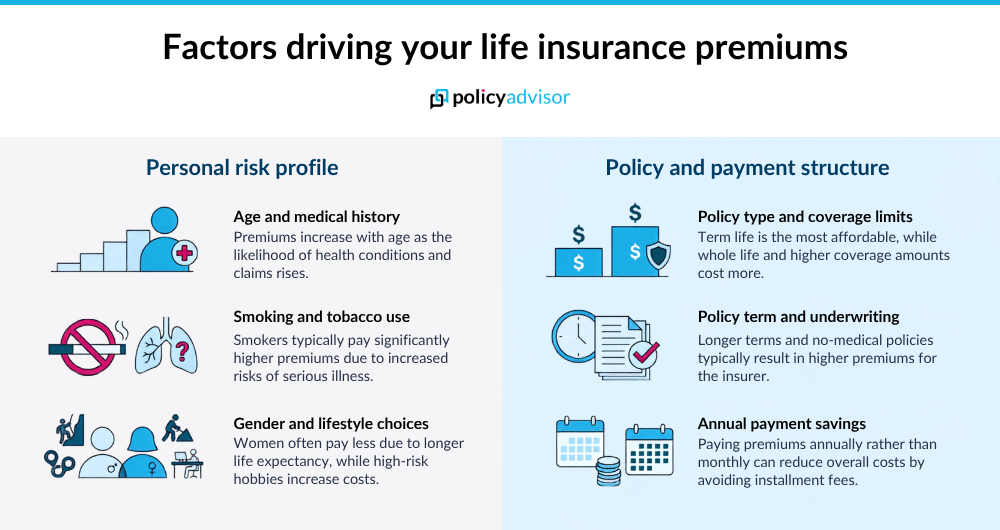
The key factors affecting life insurance premiums include age, gender, smoking status, overall health, and a few others. Here are the key factors that affect your premium:
Personal risk profile:
- Age: Your premiums increase as you get older because the likelihood of developing health conditions and making a claim rises with age
- Health and medical history: Insurers assess your current health, pre-existing medical conditions, family medical history, height, weight, and prescription medications to determine your level of risk
- Smoking status: Smokers and tobacco users typically pay significantly higher premiums than non-smokers due to the increased risk of serious illnesses
- Occupation: People working in high-risk jobs, such as construction, mining, or aviation, may pay higher premiums due to a greater risk of injury or death
- Lifestyle and hobbies: Activities such as skydiving, scuba diving, rock climbing, or private aviation may increase premiums because they carry a higher risk of accidental death
- Gender: Women often pay lower premiums than men because they generally have a longer life expectancy
Policy and payment structure:
- Coverage amount: Higher coverage limits result in higher premiums because the insurer may have to pay a larger death benefit
- Policy type: Term life insurance is generally the most affordable option, while whole life and no-medical life insurance cost more because they provide lifelong coverage and may include cash value growth
- Policy term: For term life insurance, longer terms generally cost more than shorter terms because coverage lasts longer
- Underwriting type: Fully underwritten policies usually offer lower premiums for healthy applicants, while no-medical life insurance costs more because insurers accept more risk without a medical assessment
- Payment frequency: Paying annually rather than monthly can reduce your overall insurance costs, as some insurers charge an instalment fee for monthly payments
- Insurance company: Premiums vary between insurers, even for the same applicant profile, because each company uses its own underwriting guidelines and pricing models. Comparing quotes from multiple insurers can help you find the lowest rate
Does gender affect premiums in Canada?
Yes, gender can affect life insurance premiums in Canada. Women generally pay lower premiums than men of the same age and health profile. This is because women have a higher average life expectancy, which typically translates to a lower risk of the insurer paying a claim earlier. For example, a healthy 30-year-old non-smoking woman can get $100,000 of 20-year term life insurance for about $8.19 per month, compared to $9.45 per month for a man.
Which companies offer the cheapest life insurance plans in Canada?
Based on PolicyAdvisor quote comparisons in mid‑2026, Beneva consistently offer some of the lowest premiums for term life insurance, while Foresters is often competitively priced for whole life insurance. If you are looking for no-medical coverage, the most affordable insurer is UV Insurance.
Also, the premium rates shift by age, coverage amount, health class, and province, so the cheapest insurer changes from person to person. As a result, the cheapest insurer for one person may not be the cheapest for another.
Cheapest term life insurance companies
Beneva, BMO, and Canada Life are among the cheapest term life insurance companies in Canada, offering consistently competitive premiums across different age groups. All three insurers provide affordable coverage; they differ in who they suit the most.
Beneva offers the lowest premiums, with rates starting at $10.80 per month for a healthy 20-year-old non-smoker purchasing $100,000 of 10-year term coverage and rising to $97.11 per month at age 60. BMO closely matches Beneva, with premiums ranging from $10.80 to $103.41 per month, while Canada Life remains competitively priced at $11.36 to $107.46 per month.
Cost of term life insurance by insurers
| Age (in years) | Beneva | BMO | Canada Life |
| 20 | $10.80 | $10.80 | $11.36 |
| 30 | $10.98 | $11.34 | $11.85 |
| 40 | $14.85 | $14.94 | $16.30 |
| 50 | $32.85 | $32.85 | $36.80 |
| 60 | $97.11 | $103.41 | $107.46 |
Disclaimer: Illustrative monthly cost of a 10-year term with $100,000 in coverage for a male non-smoker
Cheapest whole life insurance companies
The cheapest whole life insurance companies in Canada include Foresters, Desjardins, Sun Life, and a few others. While all three insurers provide affordable permanent life insurance, they each cater to different needs. For a healthy, non-smoking applicant purchasing $100,000 of 20-pay non-participating whole life insurance, Foresters offers the lowest premiums across all age groups, starting at $70.74 per month at age 20 and increasing to $319.41 per month at age 60. Desjardins follows closely with premiums ranging from $78.21 to $333.72 per month, while Sun Life offers rates between $91.17 and $346.41 per month.
Cost of whole life insurance by insurer
| Age (in years) | Foresters | Desjardins | Sun Life |
| 20 | $70.74 | $78.21 | $91.17 |
| 30 | $100.35 | $105.66 | $114.21 |
| 40 | $141.66 | $151.29 | $166.23 |
| 50 | $223.83 | $235.26 | $267.12 |
| 60 | $319.41 | $333.72 | $346.41 |
Disclaimer: Illustrative monthly cost of a non-participating whole life insurance with $100,000 in coverage for a male non-smoker (20-Pay)
Cheapest no-medical life insurance companies
UV Insurance, Assumption Life, and Canada Protection Plan are among the cheapest no-medical life insurance companies in Canada, offering competitive premiums for applicants who want coverage without undergoing a medical exam. These insurers are good options for people with pre-existing health conditions, those who have been declined for traditional life insurance, or anyone looking for a faster and simpler application process. UV offers the cheapest premiums starting at $13.50 per month for no-medical life insurance plans.
Cost of no-medical insurance by insurers
| Age (in years) | UV Insurance | Assumption Life | Canada Protection Plan (Foresters Life) |
| 20 | $13.50 | $14.40 | $18.00 |
| 30 | $13.95 | $15.30 | $18.81 |
| 40 | $14.85 | $19.26 | $20.16 |
| 50 | $25.38 | $41.40 | $35.64 |
| 60 | $80.37 | $131.13 | $87.66 |
Disclaimer: Illustrative monthly cost of a 10-year no-medical plan with $100,000 in coverage for a male non-smoker
What is the cheapest life insurance option for seniors?
Seniors can find the cheapest life insurance in Canada through traditional term life or no-medical exam policies. While the life insurance premiums for seniors are higher due to age and health risks, they can still find affordable coverage by comparing plans and choosing basic coverage amounts. Some of the companies offering affordable life insurance for seniors include Canada Life, Desjardins, and Sun Life.
A senior citizen can get $250,000 of 10-year term life insurance for about $98.33 per month at age 60. Even at age 70, term life costs $293.40 per month, making it considerably more affordable than whole life insurance, which costs $1192 per month. However, by age 80, many insurers no longer offer new 10-year term policies. Whole life insurance is more expensive but provides lifelong protection. Monthly premiums for a $250,000 20-pay non-participating whole life policy start at $765.45 at age 60 and increase to $2,070.90 by age 80.
Term life vs whole life insurance costs for seniors
| Age (in years) | 10-Year Term Life | 20-Pay Whole Life |
| 60 | $98.33 | $765.45 |
| 65 | $173.03 | $950.97 |
| 70 | $293.40 | $1,192.75 |
| 75 | $557.33 | $1,525.53 |
| 80 | – | $2,070.90 |
Disclaimer: Illustrative monthly premiums for non-smoking male purchasing $250,000 of coverage for a 10-year term life policy and a 20-pay non-participating whole life policy. Actual premiums vary based on different factors.
Which is the cheapest life insurance option for individuals with pre-existing conditions?
Individuals with pre-existing conditions can access affordable life insurance through no-medical plans such as guaranteed-issue or simplified-issue policies. These plans do not require medical exams and offer faster approval, making them accessible to those who may not qualify for traditional or fully underwritten coverage. However, premiums are generally higher than traditional life insurance because insurers assume more risk.
No-medical life insurance policies generally fall into two categories:
- Guaranteed-issue: Coverage is guaranteed regardless of your health, with no medical exam or health questions. Usually imposes a two-year waiting period for non-accidental death
- Simplified-issue: Applicants answer a short series of health questions but do not need a medical exam. Depending on the insurer and your health history, coverage may begin immediately or include a deferred benefit period.
Some of the providers offering no-medical exam or guaranteed-issue life insurance in Canada include Manulife, Sun Life, Empire Life, Canada Protection Plan, iA Financial Group, and Assumption Life. Insurers evaluate eligibility based on specific conditions, recency, and severity, which may lead them to decline coverage, impose waiting periods, or apply deferred benefits. Some of the pre-existing conditions that these companies commonly cover include:
- Diabetes
- Heart disease or history of heart surgery
- Cancer history (recently treated or in remission)
- Chronic obstructive pulmonary disease (COPD) or other chronic respiratory conditions
- Mental health conditions such as major depressive disorder or bipolar disorder
- Liver or kidney disease
What is the cheapest life insurance option for estate planning?
Whole life insurance is generally the most suitable option for estate planning, even though it has higher premiums than term life insurance. That is because estate planning requires lifelong coverage, and whole life insurance guarantees a tax-free death benefit whenever you pass away, provided the policy remains in force.
It can also build guaranteed cash value, making it a valuable financial planning tool. Compared to renewing multiple term policies later in life, purchasing whole life insurance earlier can provide greater long-term value. Based on PolicyAdvisor’s quote comparisons, some of the companies offering the cheapest options for estate planning include Foresters, Desjardins, and Sun Life, and a few others.
What is the most affordable life insurance option for smokers?
Smokers can get the most affordable life insurance in Canada with term life insurance. Although smokers pay higher premiums than non-smokers, term life still offers the lowest rates compared with other types of life insurance.
Premiums for smokers reflect the increased health risks and shorter life expectancy associated with tobacco use. For example, a 30-year-old smoker male in average health may pay over $60 per month for a 20-year term life policy with $500,000 in coverage. Alternatively, a non-smoker of the same age would pay around $30 per month for the same policy.
Some of the best life insurance companies, like Canada Life, iA Financial Group, Beneva, Wawanesa, and a few other insurers, offer competitive term life policies for smokers. Premiums are higher; however, term life insurance remains the most budget-friendly option for smokers seeking substantial coverage at manageable costs.
Tips to get the most affordable life insurance premiums in Canada
Your age and health influence how much you pay for life insurance; there are several ways to reduce your costs. Choosing the right policy, comparing quotes from multiple insurers, and applying while you are healthy can help you secure lower rates without compromising on coverage.
- Buy life insurance when you are young: Premiums are lowest when you are younger because you are generally healthier and present a lower risk to insurers. Buying a life insurance policy early can save you money compared with buying it later
- Compare multiple insurers: Life insurance rates can vary significantly between insurance companies for the same applicant profile. Comparing quotes across the top life insurance companies in Canada helps you find the best coverage at the lowest price
- Choose the right policy duration: Select a policy duration that matches your financial obligations, such as your mortgage or your children’s dependent years. A shorter term generally costs less than a longer one
- Consider fully underwritten coverage: If you are in good health, a fully underwritten policy usually offers lower premiums than no-medical life insurance because the insurer can better assess your risk
- Quit smoking before you apply: Non-smokers pay substantially lower premiums than smokers. Many insurers will offer non-smoker rates once you have been tobacco-free for a qualifying period, typically 12 months
- Buy only the coverage you need: Choosing an appropriate coverage amount based on your income, debts, and your family’s financial needs helps you avoid paying for unnecessary protection
- Review your coverage regularly: As your mortgage decreases, children become financially independent, or your income changes, you may be able to adjust your coverage to better match your needs and avoid paying for excess insurance
Our advisor’s take on cheapest life insurance in Canada
At PolicyAdvisor, our licensed advisors help Canadians compare life insurance quotes from over 30 insurers to find the most affordable coverage based on their age, health, budget, and financial goals. Recently, one of our advisors assisted a 35-year-old father who wanted to protect his family’s finances while keeping his monthly premiums as low as possible.
The client profile
- Age: 35 years old
- Coverage required: $500,000
- Health: Healthy, non-smoking male
- Primary goal: Affordable coverage to replace income and protect his young family
Our advisor recommendation:
After comparing quotes from several leading Canadian insurers, we found that Beneva offered the most competitive premium for a 20-year term life policy, with BMO and Canada Life close behind. While whole life insurance would have provided lifelong coverage and cash value, the client only needed protection until his mortgage was paid off and his children became financially independent. Based on those goals, term life insurance from Beneva delivered the best value at the lowest cost.
How to buy affordable life insurance through PolicyAdvisor?
You can apply for the most affordable life insurance in Canada by comparing top insurers and choosing a policy that fits your budget and coverage needs. At PolicyAdvisor, we partner with more than 30 top Canadian insurers, including Manulife, Canada Life, and Sun Life, so you can compare the cheapest rates side by side.
Once you find the right policy, you can apply online instantly or speak with a licensed advisor for personalized support. PolicyAdvisor also provides reliable after-sales assistance, helping you manage your policy after purchase. Schedule a call to get life insurance quotes tailored to your needs today!
Frequently asked questions
What is the cheapest type of life insurance policy?
Term life insurance is the cheapest type of life insurance. Since it only covers you for a set period (like 10 or 20 years) and does not build cash value, premiums are significantly lower than permanent policies.
Is the cheapest life insurance always the best option?
No, the cheapest life insurance policy isn’t always the best choice. While affordability is important, the right policy should also provide enough coverage, match the length of time you need protection, and offer features that suit your financial goals. Choosing the lowest premium without considering your needs could leave you underinsured or paying for a policy that doesn’t provide the benefits you require.
How much does the cheapest life insurance cost in Canada?
The cheapest life insurance in Canada is term life insurance, with premiums starting at around $10 per month for a healthy, non-smoking 20-year-old purchasing $100,000 of 20-year term life insurance. Your actual premium depends on factors such as your age, health, smoking status, coverage amount, and the insurer you choose.
Who qualifies for the cheapest life insurance rates in Canada?
The lowest life insurance premiums are typically available to young, healthy non-smokers with no significant medical conditions or high-risk hobbies. Applicants who purchase coverage at a younger age, maintain a healthy lifestyle, and qualify for fully underwritten policies generally receive the best rates.
Which life insurance company is the cheapest in Canada?
There is no single insurer that is the cheapest for everyone. Beneva, BMO, and Canada Life often offer the lowest term life insurance premiums, while Foresters, Desjardins, and Sun Life are competitively priced for whole life insurance.
Can I switch to a cheaper life insurance policy later?
Yes, you can replace your existing life insurance policy with a cheaper one if you qualify. However, your new premium will be based on your current age and health, so switching isn’t always less expensive. It is best to compare quotes and ensure your new policy is active before cancelling your existing coverage.
Should I choose term life or whole life if I want the lowest premiums?
If your goal is to pay the lowest possible premium, term life insurance is the better choice because it offers temporary coverage at a much lower cost than whole life insurance. However, if you need lifelong protection, guaranteed cash value, or estate planning benefits, paying more for whole life insurance may provide better long-term value.
What is the most expensive life insurance policy in Canada?
Permanent insurance and no medical exam insurance are the most expensive types of insurance policies in Canada. A permanent policy gives you lifelong coverage and a cash value component, which contributes to its higher premiums. You can use this cash value to access growth and build wealth during your lifetime.
No medical exam insurance helps applicants who may not qualify for fully underwritten coverage. Guaranteed-issue plans accept all eligible applicants, though they usually have a waiting period for non-accidental death. Simplified-issue plans ask health questions and may decline applicants; coverage is not guaranteed. Premiums are higher because insurers take on more risk.
Term life insurance is the cheapest life insurance option in Canada, while whole life and no-medical policies cost more due to lifelong coverage and simplified underwriting. Comparing insurers, policy types, and quotes can help you secure affordable coverage that matches your financial needs. Understanding the factors that affect premiums can also help you reduce your long-term insurance costs.